People quote "10%", "5.6%", "28%" and "97%" for llms.txt as if they measured the same thing. They don't. Below is every llms.txt study we could find, read on its publisher's own page on Oct 9, 2026, sorted by what it measured: whether sites have the file, whether AI crawlers request it, and whether having it gets a site cited more. For what Google and the AI companies themselves say about the file, see Does llms.txt work?.
What an llms.txt file contains
llms.txt is a proposed standard, not an official one. Jeremy Howard published the proposal on Sep 3, 2024, and its own page calls it an informal overview that is open for community input (llmstxt.org, read Nov 14, 2026). It is a structured Markdown document written for language models and the agents built on them, meant to give an LLM a short map of a website's most useful content instead of making it work through navigation menus and scripts. The parts, in the order the proposal requires:
- An H1 with the name of the project or website. This is the only required part.
- A blockquote summary holding the key information needed to understand the rest.
- Optional detail: paragraphs, lists or other Markdown blocks, but no headings.
- File-list sections: any number of H2 sections, each a list of links in the form
[name](url), with optional notes after a colon. - An "Optional" H2 section for secondary links an agent can skip when it needs less context.
The proposal also suggests clean Markdown versions of pages (add .md to the page address) so models can read documentation without the surrounding HTML. The separate llms-full.txt that many sites publish, with the whole content in one file, is not described on the proposal's page, so we count it only where a study says so.
1. How many sites have an llms.txt file
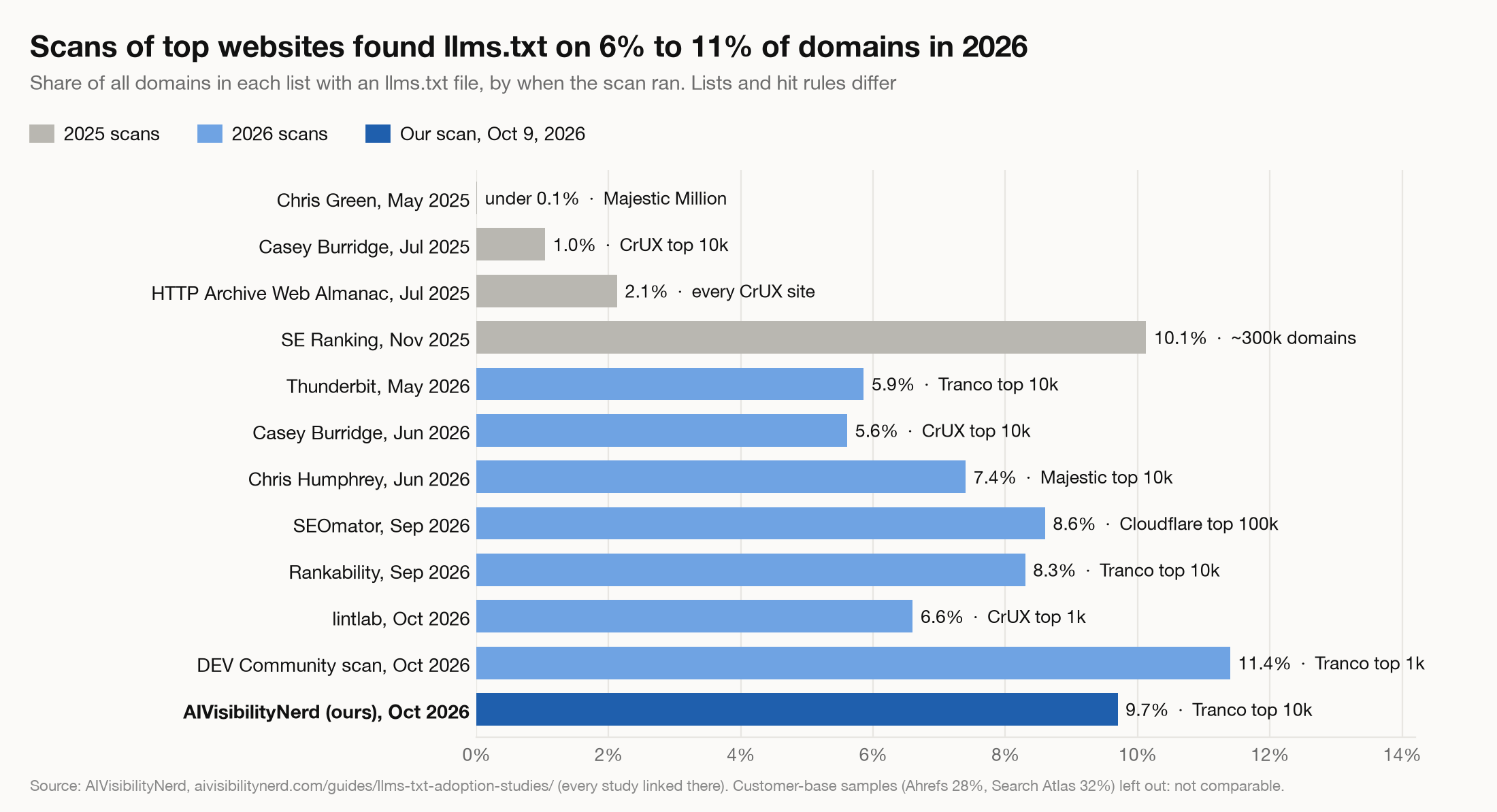
Scans of top-sites lists first, newest first, then other samples. "Hit" is what each study counted as a real file. Figures as published, except where marked.
| Study | Headline | Sites checked | What counted as a hit | Out of | Result |
|---|---|---|---|---|---|
| AIVisibilityNerd (this site) Oct 9, 2026 |
9.7% | Tranco top 10,000 (list PY35J), top 1,000 reported separately, crawled Oct 9, 2026 | 200, not HTML, not a soft-404, not a catch-all host, final URL still a .txt file; /llms.txt only | Both: all 10,000 and the 7,716 that answered over HTTP | 968 of the top 10,000 domains (9.7%); 12.5% of the 7,716 that answered. Top 1,000 alone: 102 (10.2%), or 15.0% of the 679 that answered. Another 1,069 returned 200 with an HTML page, a soft-404 or an empty body. 14.9% of the files also have an llms-full.txt. |
| Rankability Sep 18, 2026 |
9.3% | Tranco top 1,000 and top 10,000 (list V3YPN), crawled Sep 18, 2026 | 200, text, recognizable Markdown; HTML and empty replies rejected; catch-all hosts marked unknown | All domains, including 474 of the top 1,000 it couldn't decide | 9.3% of the top 1,000 (93) and 8.3% of the top 10,000 (830) serve llms.txt or llms-full.txt. Its June 2026 figures (8.7%, 5.6%) came from an older scanner and list; it says not to read them as a trend. |
| SEOmator Sep 13, 2026 |
8.6% | Cloudflare Radar top 100,000, crawled Sep 13, 2026 | 200 with a non-HTML, non-JSON body of 20+ bytes; pages that challenge bots rejected | Both: all 100,000 and the 75,353 that answered | 8,598 domains: 8.6% of all, 11.4% of those that answered. 10,775 more returned an HTML page with a 200. Shopify made 18.2% of the files found. |
| Mahiro Hirakawa (DEV Community) Oct 6, 2026 |
15% | Tranco top 1,000 (list 56WKN), crawled Oct 6, 2026 | 200 plus checks on the first byte, an H1 and the final URL | Reachable only (742 of 1,000) | 114 domains, 15% of the 742 that answered over HTTPS (11.4% of all 1,000, our arithmetic). 246 answered with a 200. |
| lintlab Oct 2, 2026 |
6.6% | Chrome UX Report top 1,000 origins, crawled Oct 2, 2026 | 200 with a plain-text or Markdown content type; body not inspected | All 1,000 | 66 of 1,000 origins. 112 more returned a 200 with some other content type. |
| Casey Burridge Jun 20, 2026 |
5.61% | HTTP Archive crawl, Chrome UX Report rank buckets, crawled monthly, Jul 2025 to Jun 2026 | HTTP Archive's llms_txt_validation field (real, parseable file; soft-404 HTML rejected) | Sites HTTP Archive crawled in each bucket (7,504 in the top 10,000) | 5.61% of the top 10,000 in June 2026 (421 of 7,504 crawled), up from 1.04% in July 2025. Top 1,000: 6.28%; top 1 million: 5.07%. |
| Chris Humphrey Jun 18, 2026 |
7.4% | Majestic Million top 10,000, crawled Jun 2026 | Real Markdown file; HTML soft-404s rejected | All 10,000 | 737 domains (7.4%). 1,050 returned a 200, but 313 of those were HTML pages. 12% of real files were plugin-generated. |
| Thunderbit May 8, 2026 |
5.86% | Tranco top 10,000 (downloaded May 6, 2026), crawled May 6, 2026 | HTML, app shells and off-path redirects rejected | All 10,000 (handling of unreachable domains not stated) | 586 of the top 10,000 (5.86%); 75 of the top 1,000 (7.50%). It saw 1,606 replies with a 200; only 586 passed. llms-full.txt: 1.03%. |
| HTTP Archive Web Almanac 2025 (SEO chapter) Jan 15, 2026 |
2.13% | Every Chrome UX Report origin (about 15.4M mobile, 12.2M desktop), crawled Jul 2025 | "Valid" file; rule not spelled out in the chapter | All crawled sites | 2.13% of desktop and 2.10% of mobile sites; 324,184 valid files on mobile. The whole web, a year earlier than the scans above. |
| SE Ranking Nov 7, 2025 |
10.13% | Nearly 300,000 domains; source of the list not stated | Not stated | All domains in its dataset | 10.13% had an llms.txt file. Also tested citations (see below). Covered by Search Engine Journal on Nov 20, 2025. |
| Nicolas Sitter Mar 21, 2026 |
6.3% | 105,002 hotel websites in 7 countries, crawled Mar 2026 | Not clear from the page | Reachable hotel sites | 6.3% of hotel sites; 12.4% in the US, 3.8% in France. WordPress SEO plugins made a third of the files. |
| Ahrefs Jun 15, 2026 |
28% | 137,210 sites using Ahrefs Web Analytics (its customers), crawled May 2026 | 200, Markdown not HTML, pages saying "404" or "Page not found" rejected | All 137,210 | 38,360 valid files (28%). Ahrefs calls it an upper bound: its customers are SEO-minded. |
| Search Atlas Jun 19, 2026 |
32.2% | 18,621 active domains in its study cohort | Clean file vs clean 404; 4,710 ambiguous replies dropped | 13,911 domains left after dropping ambiguous replies | 5,997 domains (32.2%). Search Atlas notes this is far above the ~10% in broad scans. |
| Originality.ai Jul 2, 2026 |
36,120 | Its own monitor of 3M+ sites (list not published), crawled Jun 2025 to May 2026 | Not described | Counts only, no percentage | 36,120 sites with llms.txt by May 2026, up from 4,088 in June 2025 (8.8x). |
| Chris Green May 11, 2025 |
105 | Majestic Million (all 1M), crawled Feb and May 2025 | Not described | All 1 million | 15 sites in February 2025, 105 in May 2025 (0.011%). The post also says "0.015%" for the 15 sites; 15 in a million is 0.0015%. |
The scans of top-sites lists done in 2026 (Rankability, SEOmator, the DEV Community post, lintlab, Burridge, Humphrey, Thunderbit and ours) land between 5.1% and 11.4% of all domains checked. The two figures far above that, Ahrefs' 28% and Search Atlas' 32.2%, come from sites that use SEO software, which are much more likely than the average site to follow SEO advice. The Web Almanac's 2.1% covers the whole web in July 2025, when the file was newer.
2. Do AI crawlers ask for the file?
Server-log studies: who actually requested /llms.txt.
| Study | Headline | Sites and window | Result |
|---|---|---|---|
| Ahrefs Jun 15, 2026 |
97% unread | 38,360 customer sites with a valid file; May 2026 | 97% of the sites with a valid file got no request for it in May. Bots made 96% of the requests that did arrive, and SEO audit tools outnumbered AI assistants and AI search bots. |
| EZY Jul 27, 2026 |
7 reads | 83 sites on its own platform; Apr 27 to Jul 19, 2026 | OpenAI's crawlers fetched llms.txt 7 times and robots.txt 3,990 times. Anthropic 9 vs 3,120; Perplexity 0 vs 775; Googlebot 67 vs 5,125. Only Meta's crawler read it more than robots.txt (193 vs 172). |
| OtterlyAI Feb 5, 2026 |
0.1% | 1 site; 90 days | 84 of 62,100+ AI bot visits asked for /llms.txt (OtterlyAI rounds it to 0.1%). The average content page got about three times as many AI bot visits. |
| Senthor Jan 25, 2026 |
104 of 10M | 10M+ identified AI requests it logged since Sep 2025 | 104 requests for llms.txt, none from an identifiable AI company. |
| MaxAEO (vendor) Jun 11, 2026 |
41 requests | 19 customer sites that publish the file; Feb to Apr 2026 | GPTBot, OAI-SearchBot, ClaudeBot, PerplexityBot and Google-Extended asked for llms.txt 41 times, on 3 of the 19 sites, against about 1.1 million AI page fetches. |
| Evil Martians Jul 21, 2026 |
37 of ~770 | Its own site; two months | About 770 direct fetches of its llms files; 37 came from named AI assistants and crawlers. "The file is popular, just not with the audience it was built for." |
| DEJAN (Dan Petrovic) Aug 15, 2026 |
4 fetches | dejan.ai; 30 days | llms.txt was fetched 157 times, but only 4 times by Google, Anthropic and OpenAI crawlers, which fetched robots.txt 1,150 times. |
| WISLR (Tony Castillo) Mar 20, 2026 |
0 | wislr.com; Feb 1 to Mar 20, 2026; 12,099 bot requests | No AI bot requested /llms.txt. A follow-up on 3 sites through July (Jul 20, 2026) found CCBot, ClaudeBot and Googlebot fetching it, but not GPTBot. Follow-up |
| tools.belchamber.us Sep 24, 2026 |
0 | 5 small sites run by the author; Sep 17 to 24, 2026 | Named AI crawlers made 5,819 requests; none fetched llms.txt. Its 330 llms.txt requests were mostly the author's own monitoring. |
| Saaslinks Aug 3, 2026 |
0 | saaslinks.net; 14 days, Jul 20 to Aug 3, 2026 | AI crawlers fetched robots.txt 723 times and its pages 151 times, and llms.txt never. The 13 llms.txt requests came from browsers, profilers and its own checks. |
| AWRSHIFT Jul 31, 2026 |
0 | Its own site; 12 days in Jul 2026; 9,645 requests | About a thousand AI crawler requests, no external fetch of llms.txt. All 39 fetches were its own tools. |
The pattern holds from one site to Ahrefs' 38,000: the same AI crawlers that fetch robots.txt thousands of times rarely or never fetch llms.txt. Most requests for the file come from SEO audit tools, scanners like the ones in section 1, and site owners checking their own file. The newest data shows some crawlers starting to look (Anthropic's and Google's in WISLR's follow-up, Meta's in EZY's), while OpenAI's crawlers fetched it 7 times in 12 weeks across EZY's 83 sites and not at all in WISLR's follow-up.
3. Does having one get you cited more?
| Study | Headline | Sample | Result |
|---|---|---|---|
| SE Ranking Nov 7, 2025 |
No effect | Nearly 300,000 domains | No correlation between having llms.txt and how often a domain is cited by AI. Removing the llms.txt variable made its XGBoost model more accurate. |
| Search Atlas Jun 19, 2026 |
No lift | 13,911 domains; Copilot, Gemini, AI Mode, Grok, OpenAI, Perplexity | No meaningful visibility advantage for sites with the file. Better-written files went with better visibility, but that mostly vanished once domain authority was controlled for. |
| MaxAEO (vendor) Jun 11, 2026 |
+0.2 pt | 240 matched pairs of domains | Cited in 11.8% of tracked prompts with llms.txt vs 11.6% without, inside its own week-to-week noise. |
Three studies, three methods (correlation and machine learning, a three-step control for domain authority, matched pairs), one answer: no measurable lift. All three are by companies that sell SEO or AI visibility software, and none is peer-reviewed.
Why the adoption numbers disagree
1. The denominator. A list of "top domains" is full of names that aren't websites: CDN hosts, ad servers, API endpoints. In our Tranco scan, 1,599 of the 10,000 domains didn't even resolve in DNS. Divide by all 10,000 and you get 9.7%; divide by the 7,716 that answered over HTTP and it's 12.5% (for the top 1,000 alone: 10.2% vs 15.0%). SEOmator (8.6% vs 11.4%) and the DEV Community post (11.4% vs 15%) show the same gap. Rankability keeps every domain in the denominator, including 474 of its top 1,000 it couldn't decide either way; its 93 hits are 9.3% of all 1,000, but 17.7% of the 526 it could decide (our arithmetic).
2. Fake 200s. Many sites answer any unknown address with their normal HTML page and a "200 OK" status. Count every 200 as a file and adoption can more than double: SEOmator saw 20,171 domains answer 200 but only 8,598 serve a real file; Thunderbit 1,606 vs 586; Humphrey 1,050 vs 737; the DEV Community post 246 vs 114; we saw 1,069 HTML pages, soft-404s or empty bodies served with a 200, next to 968 real files. lintlab only checked the content type, not the body, so its 6.6% is not filtered the same way.
3. Files nobody wrote by hand. Platforms and plugins now create llms.txt for their users. Shopify alone made 18.2% of the files SEOmator found, and WordPress SEO plugins another 9.6%. Plugins made a third of the files in the hotel study and 12% in Humphrey's. That pushes adoption up for whichever list holds more shops and WordPress sites, and says nothing about whether anyone chose to publish the file.
4. The list. Tranco blends several rankings and includes infrastructure domains; the Majestic Million ranks domains by links; the Chrome UX Report (used by HTTP Archive and lintlab) counts sites real Chrome users visit; Cloudflare Radar ranks by DNS traffic. Ahrefs and Search Atlas measured their own customers. Each list holds a different mix of software companies (which adopt most: about one in five in our sample) and other sites.
5. The date. Adoption has grown fast. Burridge measured 1.04% of the top 10,000 in July 2025 and 5.61% in June 2026; Originality.ai's count rose 8.8x in the same year; Chris Green found 15 files in the whole Majestic Million in February 2025. A study from 2025 and one from late 2026 are measuring different webs. Rankability warns against reading its June and September 2026 figures as a trend, because its scanner and list changed in between.
Our scan
On Oct 9, 2026 we requested /llms.txt from every domain in the Tranco top 10,000 (list PY35J), trying www. when the bare domain failed. A hit had to return a 200 with a non-HTML, non-empty body that wasn't an error page, a JSON error, or a catch-all reply (we also requested a made-up filename to catch hosts that answer everything), and the final address after redirects still had to be a .txt file. We counted /llms.txt only, not llms-full.txt on its own.
| Ranks | Share of all domains | Valid files | Share of those that answered |
|---|---|---|---|
| Top 1,000 | 10.2% | 102 | 15.0% (102 of 679) |
| Ranks 1,001 to 10,000 | 9.6% | 866 | 12.3% (866 of 7,037) |
| Top 10,000 | 9.7% | 968 | 12.5% (968 of 7,716) |
Result: 968 of 10,000 domains (9.7%, 95% confidence interval 9.1% to 10.3%), or 12.5% of the 7,716 that answered over HTTP. The rate barely changes with rank: the top 1,000 and the next 9,000 are within a point of each other. 14.9% of the sites with a file also publish an llms-full.txt. Among the domains we labelled by type, software and developer companies (about one in five) were far ahead of news sites, social networks and infrastructure hosts. Treat 9.7% as a lower bound: our hit rule is strict, it was one network and one run, and sites that block bots or our location count as misses. The nearest published comparison is Rankability's September scan (9.3% of the top 1,000, 8.3% of the top 10,000), on a different Tranco list and with a different hit rule (it also counts llms-full.txt and keeps undecided hosts in the denominator).
Are the files any good? Dead links and robots.txt conflicts
An llms.txt is a list of links for a model to read, so we checked whether those links work. The same day, we downloaded each of the 968 files again (961 were still served) and requested every web link in the 846 that contained at least one: 65,428 links, up to 300 unique links per file. Every link that failed was checked a second time, one request at a time and spaced out, so that a site briefly throttling us wasn't counted as broken.
1,448 of the 65,428 links (2.2%) were dead on both passes, and they sat in 252 of the 846 files (29.8%). Most files are fine, but a minority are badly out of date: 63 files had at least 10% of their links dead, 23 had at least 25%, and 7 had half or more.
| Kind of link | Links checked | Dead on both passes |
|---|---|---|
To a Markdown file (.md) | 7,882 | 4.2% |
To a text file (.txt) | 922 | 14.6% |
| To an ordinary page | 56,624 | 1.7% |
The links written for machines break most often. Many llms.txt files point to Markdown or text copies of their pages, and those copies die at about two and a half to eight times the rate of ordinary pages, perhaps because nothing on the site links to them and nobody notices when they go. 79 dead links were unfilled templates or typos, such as {locale}, {id} or https://https://, left in 7 files.
robots.txt can contradict the file. 59 of the 961 live files (6.1%) sit on sites whose robots.txt blocks at least one of five AI crawlers (GPTBot, ClaudeBot, PerplexityBot, Google-Extended, CCBot) from the whole site; 39 of them block one of the three that fetch pages for answers or agents (GPTBot, ClaudeBot, PerplexityBot), not just the training opt-outs. 58 sites disallow the llms.txt file itself for at least one of those crawlers. Those sites publish a guide for AI models while telling at least some of them to stay out.
How we counted: dead means 404 or 410, another 4xx, a 5xx or a host that doesn't exist, on both passes. Not counted as dead: 401, 403 and 429 replies (usually a bot wall or a login page, so not re-checked), timeouts and TLS errors, hosts our local network blocks but public DNS resolves, and links that worked on the second pass. Files with more than 300 links (86 of them) were checked on their first 300. robots.txt was read the way Google reads it (most specific group, longest matching rule); a missing robots.txt counts as no block. One network, Oct 9, 2026.
What this means for you
If you want to publish an llms.txt, it costs nothing and does no harm, but check its links now and then, and check that your robots.txt doesn't block the crawlers you wrote it for. Just don't expect it to change how AI assistants see you: the log studies show the main AI crawlers barely ask for it, and the citation studies show no lift. Letting the crawlers in (robots.txt and firewall rules) and ranking in ordinary search matter more, as our llms.txt guide explains. Our AI crawler checker shows both for any site, plus whether it has an llms.txt. If a tool you pay for scores you down for a missing llms.txt, compare what each tracker actually measures in our price index.
How we built this page
We searched for every published study of llms.txt adoption, requests or citations, then read each one on its publisher's own page on Oct 9, 2026, checking every figure here against the page's text. Dates are the publisher's. Not included: roundups that only repeat other studies' numbers, studies of hand-picked groups of a few hundred sites or fewer, and studies whose figures we couldn't read on the page. If we've missed a study, or a figure here has changed at its source, email hello@aivisibilitynerd.com.
Questions people ask
Is llms.txt an official standard?
No. llms.txt is a proposed standard. Jeremy Howard published it on Sep 3, 2024, and the proposal's own page calls itself an informal overview open for community input. No standards body has adopted it. Thousands of websites publish one anyway, which is why adoption studies exist.
What is in an llms.txt file?
A Markdown document with a required H1 naming the project, usually a blockquote summary, optional plain detail, then H2 sections that list links as name, address and a short note. An 'Optional' section holds links a model can skip. The idea is a structured map of the most useful content for language models.
How many websites use llms.txt?
It depends on the denominator and the list. Scans of top-site lists in 2026 land between 5.1% and 11.4% of all domains checked. Our Oct 9, 2026 scan of the Tranco top 10,000 found a valid file on 9.7% of all domains, or 12.5% of the 7,716 that answered over HTTP.
Do AI models like ChatGPT use llms.txt?
No study shows it. Server-log studies find the main AI crawlers rarely or never request the file; in EZY's data OpenAI's crawlers fetched it 7 times in 12 weeks across 83 websites. Some Anthropic, Google and Meta requests have appeared recently. Three citation studies found no lift in AI answers from having one.
Should I add an llms.txt file to my website?
It costs little and does no harm, so publishing one is reasonable if you keep its links working and make sure your robots.txt does not block the crawlers you wrote it for. Do not expect it to change how AI assistants see you. Letting crawlers in and ranking in ordinary search matter more.